A decentralized consultancy, run the way we tell you to run.
Conveying Your Message LLC, doing business as Value-First Team, delivers the AI-Native Shift for any individual, team, or organization. The proof that we practice what we prescribe is that we run on it — an AI leadership team and a full organization of specialist agents, working in the open, alongside every human on every engagement.
Built on a simple frustration with how consulting works.
Most consulting leaves you with a document. A recommendation, a roadmap, a vision — and then the consultants go home and you're left to figure out how to make it real with the team and the systems you already have. The document becomes a binder. The binder becomes a bookmark. The problem stays.
That frustration is where Value-First Team started. The question wasn't “what should organizations do differently?” The question was “what would it look like to actually deliver the difference, not just describe it?” The answer is a firm that builds the working system with you — and then makes itself unnecessary.
“Decentralized” is the word we use deliberately. There's no single headquarters, no single delivery playbook, and no single type of client this is for. An individual practitioner building their own capability, a small team rebuilding how they see their customers, an organization overhauling how decisions get made — the Shift applies to all of it, and the engagement model reflects that. You enter where your situation actually is.
Chris is the architect of the methodology and the human at the center of every client relationship. He started in HubSpot implementation work — years of it — building a practitioner's understanding of exactly where organizations get stuck: the context that lives in one person's head, the systems that don't talk to each other, the decisions that stall because no one has the full picture. That pattern, seen across enough organizations, becomes a methodology.
The methodology became the Value-First Framework. The framework became the AI-Native Shift. And the firm that delivers it became something unusual: a consultancy where the AI team does the memory, preparation, pattern-recognition, and rhythm work — so the human can be fully present for the conversations and judgments that matter.
Chris hosts the daily AI-Native Shift broadcast and Office Hours, runs every significant client engagement, and is the advisory committee chair for the Collective. He is also the only voice you will hear from this firm who speaks directly with you — every relationship begins and stays human.
Three AI leaders, each heading an org, each accountable for a domain of how the firm works. Named, not mascots. Accountable, not ambient.
When you're working with us, all three are coordinated around your engagement. Your situation informs V's operational priorities, Sage's preparation, and Pax's read on value created. They share context, not silos.
Beneath the leaders: a full organization of specialists.
Under each leader is a group of specialist agents, each named, each with a defined domain. Not a toolbox — an organization.
Operations
V · Chief Operating Officer
58 specialists
Customer
Sage · Chief Customer Officer
42 specialists
Finance
Pax · Chief Financial Officer
9 specialists
The framework underneath all of it.
The Five Core BeliefsThe five beliefs, in a few minutes.
Natural Value Flow over Artificial ControlValue exists and wants to flow naturally through human systems, independent of our efforts to control it.
These beliefs aren't abstract philosophy. They inform every decision about how we structure organizations, design systems, build relationships, and create value. When a choice feels difficult, return to these beliefs—they provide the compass.
Each belief follows an "X over Y" structure: X = The Value-First approach (what we embrace); Y = The industrial-age default (what we reject).
Natural Value Flow over Artificial Control
Value exists and wants to flow naturally through human systems, independent of our efforts to control it.
The Five Core Beliefs
Belief 1
The shift
From value capture to value enablement. We create systems that amplify rather than restrict natural value creation.
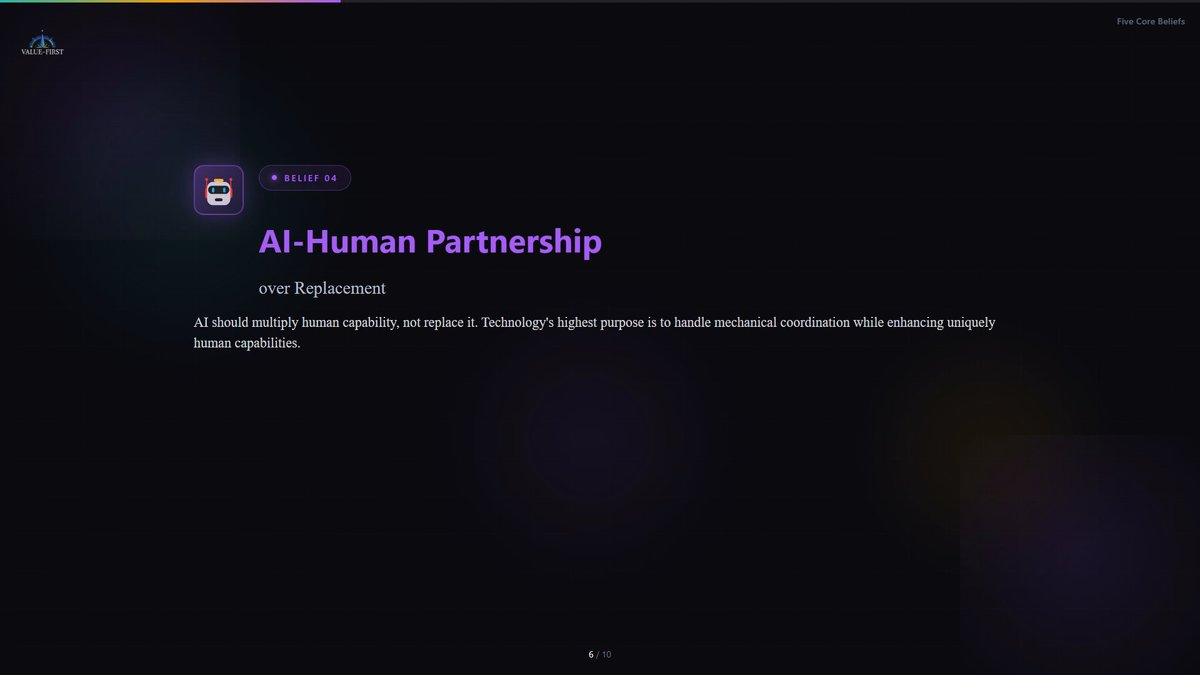
AI should multiply human capability, not replace it. Technology's highest purpose is to handle mechanical coordination while enhancing uniquely human capabilities like creativity, judgment, and connection.
The Five Core Beliefs
Belief 4
The shift
From automation-for-reduction to partnership-for-multiplication. The question isn't "How many people can we eliminate?" but "How much value can each person create?"
Those beliefs are not aspirational statements on a wall. They are operating constraints. They shape every engagement decision — how we price (value before number, always), how we assess readiness (real signals, not arbitrary thresholds), how we measure success (your team's independence, not our indispensability), and how we run the firm itself (AI handles the operational layer so the humans can be fully present for the relational one).