

The Three-Org Model

Three orgs.
No handoffs.

The organizational architecture for Value-Led Growth. Three unified organizations replace seven functional silos. The Customer Org owns the whole Value Path. Operations handles coordination complexity. Finance stewards resources.

Chief Customer Officer · AI Lead: Sage

Customer Org

Everyone who touches the value journey with and for clients, stewarding relationships across all Value Path stages without handoffs.

Everyone who creates and delivers value to clients. Owns the entire Value Path from Audience through Championβ€”from first signal recognition through championship. No artificial splits between getting customers and keeping customers.

What this org owns

  • ● Client relationship development and stewardship
  • ● Live session deliveryβ€”discovery, coaching, training, facilitation
  • ● Technical implementation and configuration
  • ● Methodology application and framework delivery
  • ● Thought leadership and market education
  • ● The entire Value Path from Audience through Champion

What it doesn't own

The Customer Org does not own internal operations, system management, platform maintenance, or functions that do not directly touch customer value creation.

AI handles

Intelligence, preparation, signal recognition, pre-call coaching, post-call analysis, documentation synthesis

Human handles

The customer conversation, judgment calls, trust, the relationship itself

Key principle

No handoffs between Value Path stages. Relationships are stewarded continuously, not transferred between functional specialists.

How we live it

At VFT, the Customer Org includes 34 specialists: relationship intelligence agents (Herald, Sentinel, Prism, Tide, Scout, Quorum, Meridian) who research and prepare; experience designers who build journeys; content creators who author customer-facing material. Each member of the Customer Org owns relationship continuity. No handoff occurs between stagesβ€”the same intelligence, preparation, and coaching capability that begins at first signal follows through to championship.

Who belongs here

  • β†’ Value Stewardsβ€”full-journey relationship owners
  • β†’ Technical delivery specialists
  • β†’ Methodology experts
  • β†’ Anyone whose work directly touches customer value creation
Primary Unified View
Unified Customer View β†’
Chief Operations Officer · AI Lead: V

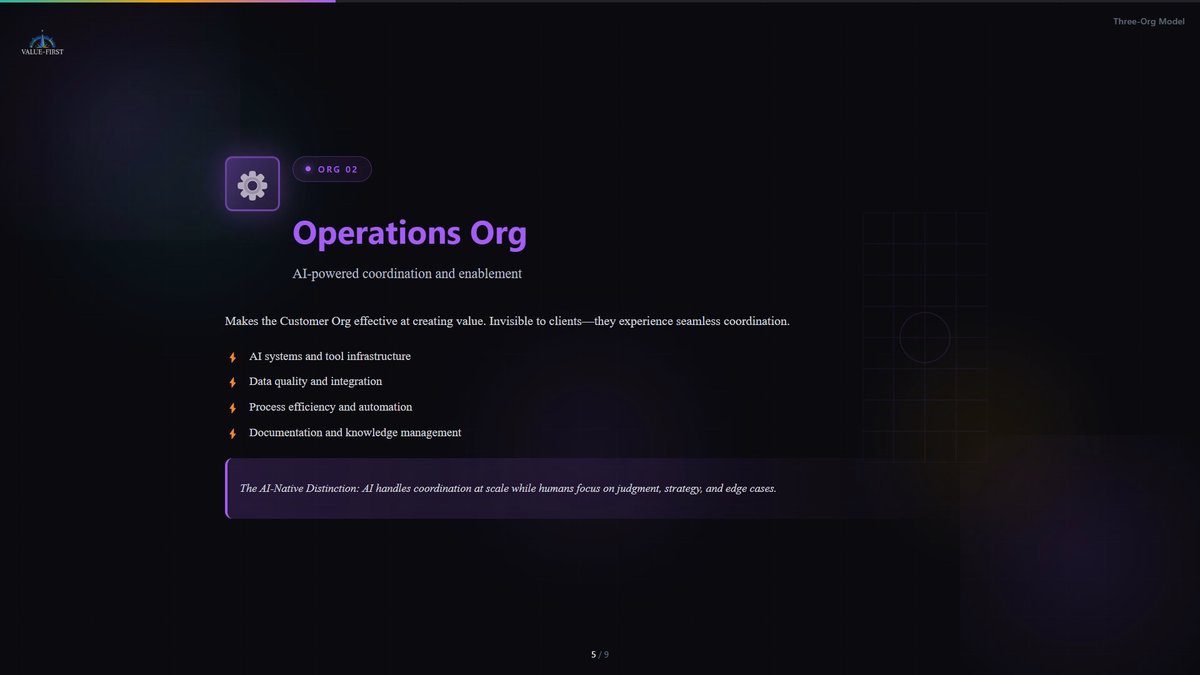
Operations Org

AI-powered systems, integration, and process automation that enable the Customer Org to operate seamlessly and at scale.

AI-powered coordination and enablement that makes the Customer Org effective at creating value.
What this org owns

  • ● AI systems and tool infrastructure
  • ● Data quality and integration
  • ● Process efficiency and automation
  • ● Platform reliability and performance
  • ● Project coordination and status tracking
  • ● Documentation synthesis and knowledge management
  • ● System and platform management
  • ● Quality assurance and process optimization

What it doesn't own

The Operations Org does not own client relationships, revenue generation, financial decision-making, or direct customer interaction.

AI handles

Coordination, integration, process automation, system management, data orchestration, memory synthesis

Human handles

Strategic infrastructure decisions, judgment on edge cases, human oversight and escalation

Key principle

Operations should be invisible to clients. They experience seamless coordination; they don't see the machinery behind it.

How we live it

At VFT, the Operations Org is AI-native: 43 agents handle content production, media management, platform operations, code health, and project coordination. V (COO) orchestrates across all functions. Example: When a session completes, Scribe (transcript processor) extracts intelligence, Vault (content database) catalogs it, Forge (content multiplier) identifies article angles, and Slate (episode pre-creation) stages new mediaβ€”all without human handoff coordination.

Who belongs here

  • β†’ AI Operations Lead
  • β†’ Platform and system administrators
  • β†’ Integration specialists
  • β†’ Process designers
  • β†’ Anyone whose work enables the Customer Org
Chief Financial Officer · AI Lead: Pax

Finance Org

Stewards resources and measures value delivered, expanding financial management beyond revenue capture to include value creation metrics.

Resource stewardship and value accountingβ€”not just tracking money, but measuring value delivered.

What this org owns

  • ● Revenue distribution based on contribution
  • ● Cash flow management and financial planning
  • ● Investment prioritization and resource allocation
  • ● Compliance and risk management
  • ● Value accounting alongside traditional financial metrics

What it doesn't own

The Finance Org does not own sales processes, marketing decisions, product development, or delivery operations.

AI handles

Revenue reconciliation, investment tracking, ROI calculation, scenario modeling, financial reporting

Human handles

Resource allocation decisions, strategic financial planning, risk assessment and compliance

Key principle

Measure value delivered, not just revenue captured. This changes investment decisions, pricing models, and resource allocation.

How we live it

At VFT, the Finance Org measures both Orders (revenue source of truth) and Investments (value creation spending). Pax (CFO) tracks: Does value delivery correlate with investment? Where does value compound versus dissipate? What multiplies human capability at what cost? Example: A client engagement tracks not just revenue closed, but relationship health, capability growth, and value delivered per dollar invested.

Who belongs here

  • β†’ CFO and finance team
  • β†’ Accounting and compliance
  • β†’ Anyone responsible for resource stewardship
Primary Unified View
Unified Revenue View β†’

Why three instead of seven

Traditional structure

Seven silos, six handoffs

Marketing generates and hands off. Sales closes and hands off. Implementation delivers and hands off. Account Management retains. Customer Success prevents churn. Support handles problems. Each function gets its own ops team.

Each department optimizes for its metrics. Customers experience seven handoffs, context lost at each transition, relationships rebuilding with each new face.

Three-Org structure

Three orgs, one continuous relationship

The Customer Org owns the entire relationship β€” no handoffs. The Operations Org handles all coordination complexity. The Finance Org stewards all resources.

Customers experience one continuous relationship. Context accumulates rather than evaporates. Trust deepens rather than resets.

Inside the Customer Org

The Value Steward role

Within the Customer Org, the primary role is the Value Steward β€” humans partnered with AI who steward relationships through the entire Value Path.

AI handles

Research, documentation, coordination, pattern recognition, operational complexity.

Human handles

Judgment, trust-building, creative problem-solving, emotional intelligence.

One Value Steward partnered with AI might steward 50–100 relationships through their entire journey β€” versus 500 contacts through a single stage. The math changes when AI is the partner, not the headcount.

OPEN PROTOCOL

This methodology is open. Read it at valuecreationprotocol.com.

We run the framework. The framework belongs to anyone who wants to learn it.

Visit the protocol home