
The printed sheet
How the Value-First Team sets up its own HubSpot portal, for HubSpot users.
An Opportunity record holds one possible partnership while we work it out together with someone.
It gathers the conversations, the proposals and the mutual evaluation. When both sides commit, an Order records it.
Who joins an Opportunity?
“… all five of these contacts associated to a deal … ‘Oh, no, one deal, one contact, one company.’”
Chris Carolan, Let’s Unbox A HubSpot Customer Data Model with Jeff Vincent, 27 June 2025
Try it in your portal
- Rename your stages. Name stages for the work both sides do, ending in a won stage (ours is Value Activated) and a lost one (Not Right Now); reports need both. Settings › Data Management › Objects › Deals › Pipelines tab. All plans.
- Snapshot what they want. Add Multi-line text properties to your Opportunities for the client’s starting point, goals and wanted outcomes. Fill them when the quote goes out; then leave them. Settings › Properties › Create property. All plans.
- Link everyone taking part. Associate every contact involved, and their Account, not one contact per Opportunity. In the record’s right sidebar, click + Add in the Contacts card. All plans; Super Admin or Edit associations permission.
What do we keep about an Opportunity?
Beyond HubSpot’s usual details, we keep:
- A copy of what they want. Their starting point, goals and wanted outcomes, copied when the quote goes out.
- What they told us. Where they are, what is in their way and the next step they are ready for, in their own words.
- Real or an example. Whether the Opportunity is real or a teaching example, which is never the source of a value claim.
- Sponsorship terms. For a show sponsorship: the show, the period and the rate.
Whose value does it serve?
Value for the Company
That means the organization doing the work. Before anything is booked, the Revenue View makes the sales conversations, the opportunities and the proposals visible.
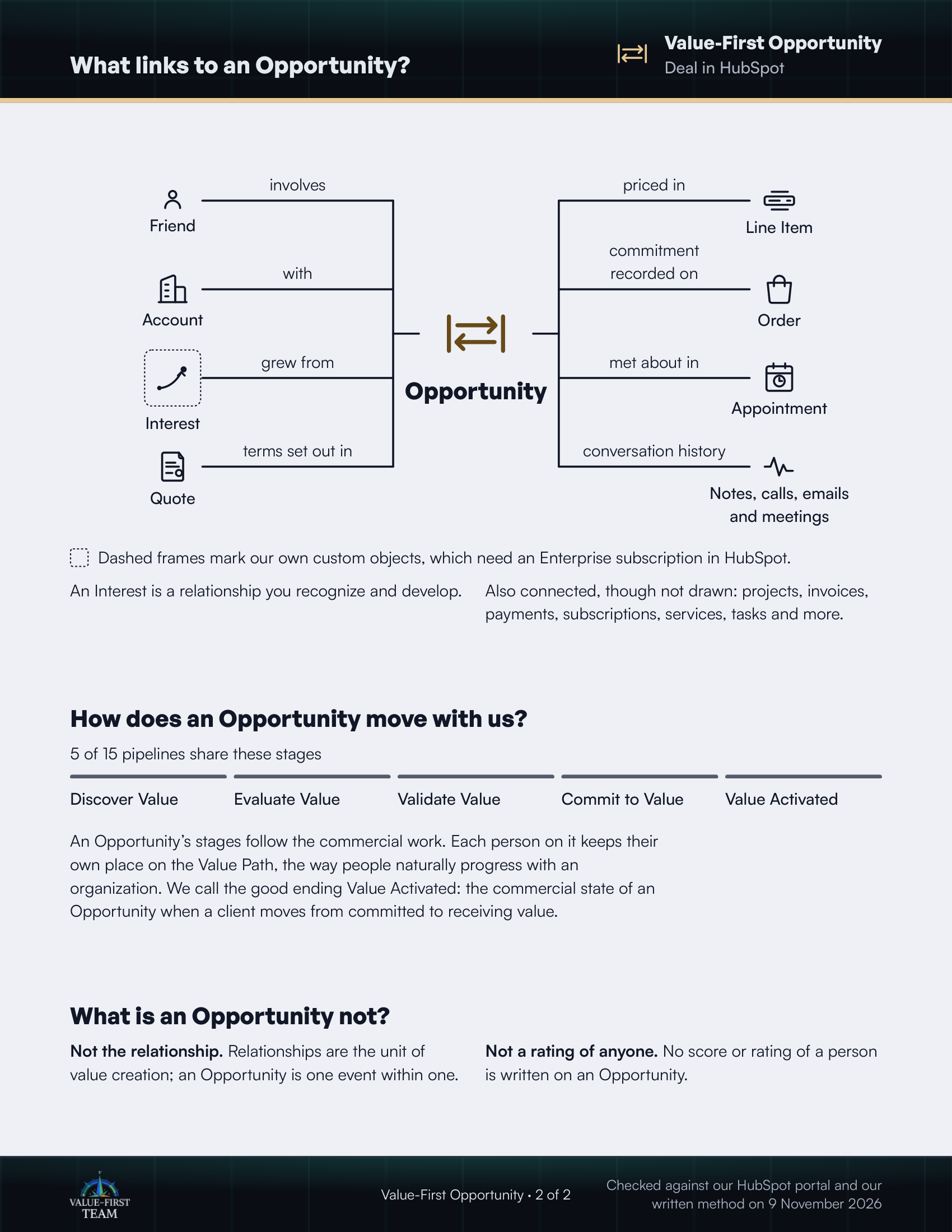
What links to an Opportunity?
- involves Friend
- with Account
- grew from Interest (custom object)
- terms set out in Quote
- priced in Line Item
- commitment recorded on Order
- met about in Appointment
- conversation history Notes, calls, emails and meetings
Dashed frames mark our own custom objects, which need an Enterprise subscription in HubSpot.
On the printed sheet these objects are drawn with dashed frames; this list gives the same links without the frames.
An Interest is a relationship you recognize and develop.
Also connected, though not drawn: projects, invoices, payments, subscriptions, services, tasks and more.
How does an Opportunity move with us?
5 of 15 pipelines share these stages
- Discover Value
- Evaluate Value
- Validate Value
- Commit to Value
- Value Activated
An Opportunity’s stages follow the commercial work. Each person on it keeps their own place on the Value Path, the way people naturally progress with an organization. We call the good ending Value Activated: the commercial state of an Opportunity when a client moves from committed to receiving value.
What is an Opportunity not?
- Not the relationship. Relationships are the unit of value creation; an Opportunity is one event within one.
- Not a rating of anyone. No score or rating of a person is written on an Opportunity.
Checked against our HubSpot portal and our written method on 9 November 2026