The Five-Layer Model

The Five-Layer Model describes any organization as five layers, stacked bottom-up — from the raw material of the business to the surfaces where humans meet it.

The same five layers are present in every organization. What changes between the Industrial Age and the AI-Native world is not which layers exist, but whether they compose. The stack reads bottom-up: each layer earns the weight of the one above it.

Ai Native ConceptsWhat AI-Native actually means, in a few minutes.
The Shift Five-layer operating model
value-first · transformation figure
The Shift from fragmented to unified

Industrial Age

Trapped — who you are in it

Fragmented tools, held together by tribal knowledge at every layer.

TK Tribal Knowledge — required to operate every layer, whether or not a system or document is in place.
Email threads
L5 · INTERFACE
Project tool (Asana / Monday)
L5 · INTERFACE
Chat (Slack / Teams)
L5 · INTERFACE
Manual processes
L4 · ORCH
Key-person-as-bottleneck
L4 · ORCH
Subject Matter Experts
L3 · INTEL
Consultants
L3 · INTEL
MQLs / SQLs
L2 · PROCESS
BANT
L2 · PROCESS
Attribution
L2 · PROCESS
CRM
L1 · DATA
ERP
L1 · DATA
Spreadsheets
L1 · DATA
Google Drive
L1 · DATA
Microsoft Office
L1 · DATA
TK
TK
TK
TK
TK
TK
TK
TK

AI-Native

Transformed — who you become

Five layers stacked bottom-up. Each earns the weight above.

HDE Human Domain Expertise — documented at every layer, intentional and shared.
AI
AI
AI
AI
HDE
HDE
HDE
HDE
LAYER 5
Interface
Every surface where humans meet you.
Customer
Value
Platform
Workspace
UI
Your
Custom
Apps
LAYER 4
Orchestration
AI-Native OS · Shared Substrate.
Automation
Governance
LAYER 3 · THE JUNCTION
Intelligence
Who has context + capability. The densest knot.
Your
Humans
Your
Agents
HDE
AI
LAYER 2
Customer Value Model
What the data means.
Unified
Customer
View
Unified
Revenue
View
LAYER 1 · FOUNDATION
Data, Identity, Context
Sources of truth, memory.
CRM
ERP
Google /
Microsoft
Two spines thread all five layers
TK Tribal Knowledge Human Domain Expertise HDE
Fragmented context Composed context
The crossing
felt painmotion — crossingarrival
Read this figure

Nothing here is thrown away. The same five layers, the same people, the same hard-won expertise live on both sides. On the left your value is real but scattered — points of light held together by tribal knowledge that walks out the door each evening. On the right that light is the same; it has simply been wired into a circuit, and the knowledge is written down where everyone can stand on it.

You are not swapping your team for machines, and you are not buying a shinier stack. You are crossing a threshold you already stand on — from fragmented to unified. Each layer earns the weight of the one above it, and the middle glows because that is where the work finally begins to move on its own.

Industrial AgeAI-Native The business world you operate inTrappedTransformed Who you are / who you become in that world

The Shift Tribal KnowledgeHuman Domain ExpertiseFragmented contextComposed context

Layer 1

Data, Identity, Context

Sources of truth, memory

What it is

The foundational layer — the org's Data, Identity, and Context, each read at the full breadth of the layer's own name. The layer NAME governs; the record-scoped wording below is illustrative of one instance, not the limit of the scope.

  • Data — every record about every customer, every interaction, every commitment, every transaction, held in a structure that lets the layers above actually use it. Not just "the data" in the spreadsheet sense — the shape of the data too.
  • Identity — who the org and its brands ARE. Broad: brand / show / person identity and voice (the identities that define how the org and its brands show up) belong here — not only the customer- and people-entity identity resolved across systems. Entity-identity-resolution is one instance of L1 Identity, not its whole scope. Identity is who you are (foundational, L1); the interface is where humans meet that identity (L5) — two distinct layers, not a false friend.
  • Context — the org's contextual knowledge, broadly. Broad: the org's documented contextual knowledge — its linked knowledge graph, durable memory, and the source material feeding them — belongs here, not only the context each record carries about why it exists. Record-attached context is one instance of L1 Context, not its whole scope.

Trapped · Industrial Age

The data is there, but it's spread across the CRM, the ERP, spreadsheets, Google Drive, Microsoft Office, and a dozen other places. Identity isn't resolved across them. Context lives in the inboxes of the people who made the decisions.

Transformed · AI-Native

The CRM, the ERP, and Google/Microsoft surfaces all feed a unified foundation that the layers above can read coherently. Identity is resolved. Context is attached to the record, not to the person who created it.

If Layer 1 is fragmented, every layer above it is doing fragmentation work — Sales is reconstructing context the Support team already had, Marketing is reaching out to customers without seeing the last conversation, AI agents are hallucinating because they can't see the underlying truth. Most "AI projects" that fail are actually Layer 1 problems wearing AI clothing.

Layer 2

Customer Value Model

Trapped framing: Internal Process Model

What the data means

What it is

The explicit model of what creates value for your customers, for whom, and why. This is the layer that answers "why does our work matter, and to whom" in operational terms — not as a slogan, but as a structure the rest of the business runs from. In an AI-Native organization, this layer is occupied by the Unified Customer View and the Unified Revenue View.

Trapped · Industrial Age

Layer 2 is occupied by internal-process models: MQLs, SQLs, BANT, attribution. The frameworks are real and the tools are real, but the shape is internal — about how the business processes the relationship — not about the value the customer is actually receiving. The Customer Value Model is implicit; the internal-process model is explicit. AI optimizes for whatever shape it can see, which is the internal one.

Transformed · AI-Native

Layer 2 is occupied by the Unified Customer View and the Unified Revenue View. The Customer Value Model is named explicitly, mapped to the Value Path stages, and queryable by both humans and AI agents. The model evolves as the business learns — but it evolves deliberately, not by accident.

Layer 2 is where most AI-native transitions are silently lost. The teams that swap MQL/SQL/BANT/Attribution for an explicit Customer Value Model gain coherence at every layer above. The teams that don't keep optimizing for internal-process metrics, with AI now amplifying the misdirection.

Layer 3

Intelligence

Who has context + capability

What it is

The layer that holds the judgment of the business — the pattern recognition, the situational reasoning, the synthesis across context that turns information into a decision. The Five-Layer Shift figure [source: "the diptych" — retired; ratified term applied] names two participants at this layer: Your Humans and Your Agents. The junction column on the right side of the Five-Layer Shift figure [source: "the diptych"] shows the change in composition: HDE (Human Domain Expertise, documented and shared) on the human side, AI (your agents) on the technological side, both present at Layer 3 in an AI-Native organization.

Trapped · Industrial Age

Layer 3 is occupied by Subject Matter Experts and consultants. The intelligence is real — but it's rented. It walks out the door when the consultant's engagement ends, when the expert retires, or when the next reorganization moves them off the account. The organization doesn't accumulate intelligence; it accumulates dependencies on the people who hold it.

Transformed · AI-Native

Layer 3 is occupied by Your Humans (with their domain expertise documented at every layer, not held in inboxes) and Your Agents (with the context Layers 1 and 2 make queryable). Intelligence becomes a property of the organization, not a property of the people the organization is currently renting.

Layer 3 is where AI either multiplies the team or replaces the wrong part of it. The organizations that document Human Domain Expertise at Layer 3 — and then add agents that operate alongside it — produce intelligence that compounds. The ones that try to replace SME judgment with AI lose the judgment and keep the cost.

Layer 4

Orchestration

How the work moves (the AI-Native OS · Shared Substrate)

What it is

The coordination layer. The substrate that lets the layers below interoperate, the agents at Layer 3 work as a team, and the apps at Layer 5 inherit a trustworthy foundation instead of fragmenting. The Five-Layer Shift figure [source: "the diptych" — retired; ratified term applied] shows two participants at Layer 4: Automation and Governance. Both glow in the Five-Layer Shift figure [source: "the diptych"] — the orchestration layer is what most organizations don't yet have, and it's the layer that determines whether everything above and below can function as an operating model rather than a pile of integrations.

Trapped · Industrial Age

Layer 4 is occupied by manual processes and key-person-as-bottleneck. The coordination that an AI-Native OS would do gets done by a person — usually the same person, repeatedly, until they leave or burn out. Automations exist, but they're point-to-point — not orchestrated.

Transformed · AI-Native

Layer 4 is the AI-Native OS. Automation and Governance, both deliberate. Agents coordinate routine work across functions. Governance keeps the agents aligned with the operating model. The substrate is shared — every new agent inherits the foundation instead of being built on its own.

Layer 4 is the layer most organizations don't realize they're missing. They have data (Layer 1). They have apps (Layer 5). They sometimes have an explicit Customer Value Model (Layer 2). They occasionally have documented intelligence (Layer 3). But Layer 4 — the orchestration that lets the other four layers actually function as a single system — is almost always implicit, almost always carried by the key-person-as-bottleneck, and almost always the answer to "why doesn't our AI work."

Layer 5

Interface

Every surface where humans meet you

What it is

Every surface where humans meet you. Layer 5 is not only internal work tools. It is every surface where a human meets the organization — internal work surfaces (email, chat, project tools, the workspace) and outbound / audience / content surfaces (public sites, social, newsletters, how you show up to an audience). (Broadened by Chris ruling, 2026-07-13.)

Trapped · Industrial Age

Those surfaces as scattered one-offs. Email threads, project tools (Asana / Monday), chat (Slack / Teams) — plus website, social posts, newsletters — each its own silo, because Layer 4 is missing. The human is the integration layer, copying context between surfaces and holding the thread together by attention and memory.

Transformed · AI-Native

One connected presence, internal team and outside audience alike — Customer Value Platform, Workspace UI, Your Custom Apps, public sites & content, audience touchpoints — all sitting on the orchestration layer that makes them coherent. AI agents show up inside those surfaces as collaborators, not as a separate app to open; the interface doesn't ask the human to be the integration layer.

This is the value-realization layer. Layer 5 is literally "where humans meet you" — the surface at which value either reaches a human or does not. A composed Layer 5 is the difference between value that is built and value that is received. And most organizations over-invest here to compensate for under-investment in Layers 2, 3, and 4 — more apps, more dashboards, more integrations — producing interface proliferation: more places to look, less coherent view. AI-native operations require fewer interfaces, not more, because the orchestration layer is doing the cross-system work that interface proliferation was standing in for.

How leaders use it

Diagnostic

Map your organization against the five layers using the Five-Layer Shift as the reference. Which layers are strong? Which are implicit? Which are held together by tribal knowledge? The diagnostic is the entry point to the program's Mindset work.

Architectural

"Should we add this dashboard?" is a Layer 5 question — and the answer is almost always to fix Layer 4 first. "Should we add another integration?" is a Layer 1 question — and the answer is usually to make the existing data coherent before adding more.

Operational

When something isn't working, the model gives you the question to ask: which layer is producing the problem? Most "AI isn't working" complaints are Layer 1 or Layer 2 problems. Most "we have too many tools" complaints are Layer 4 problems. Most "the team is burning out" complaints are key-person-as-bottleneck — Layer 4 again.

The figure set
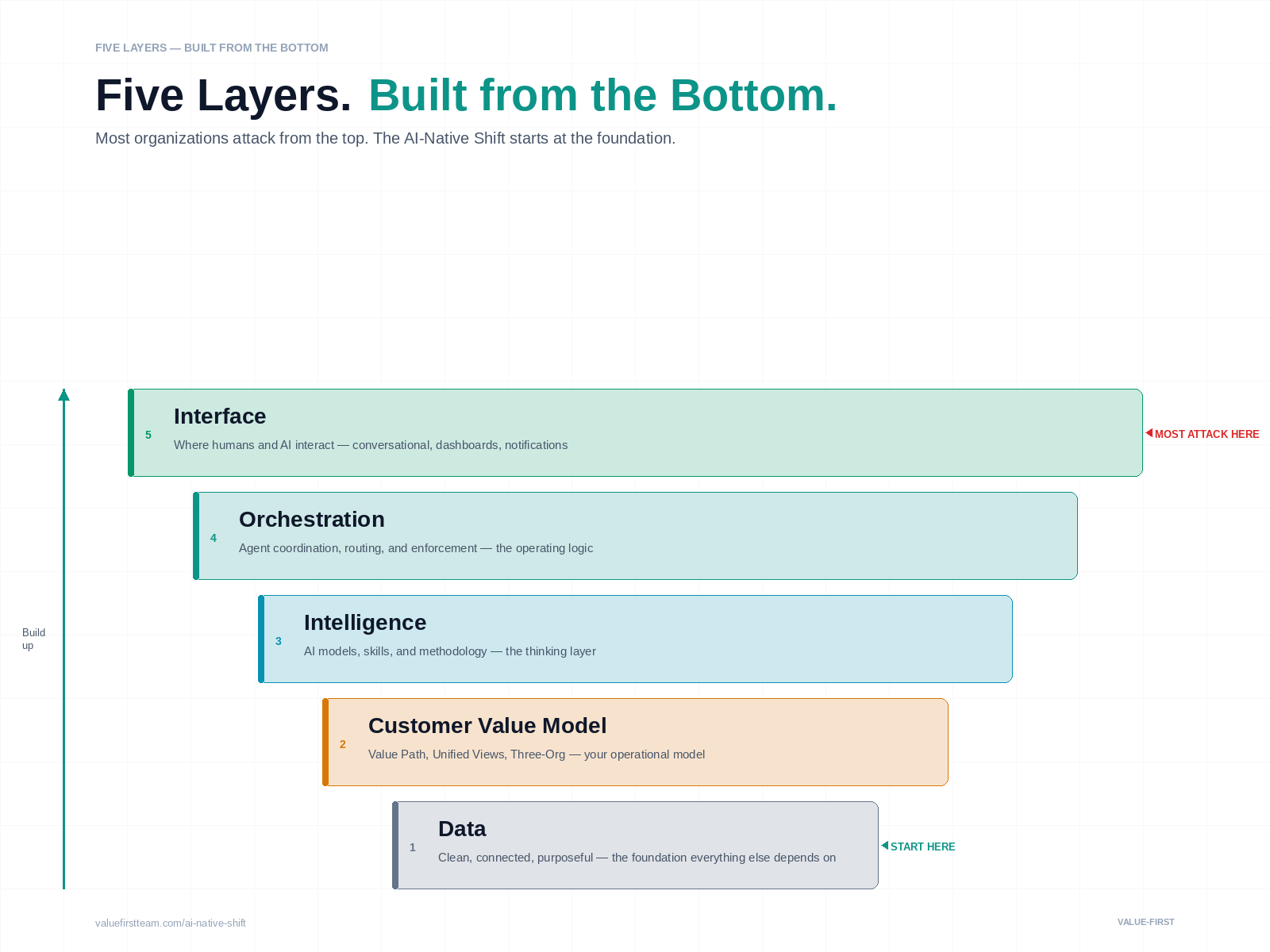
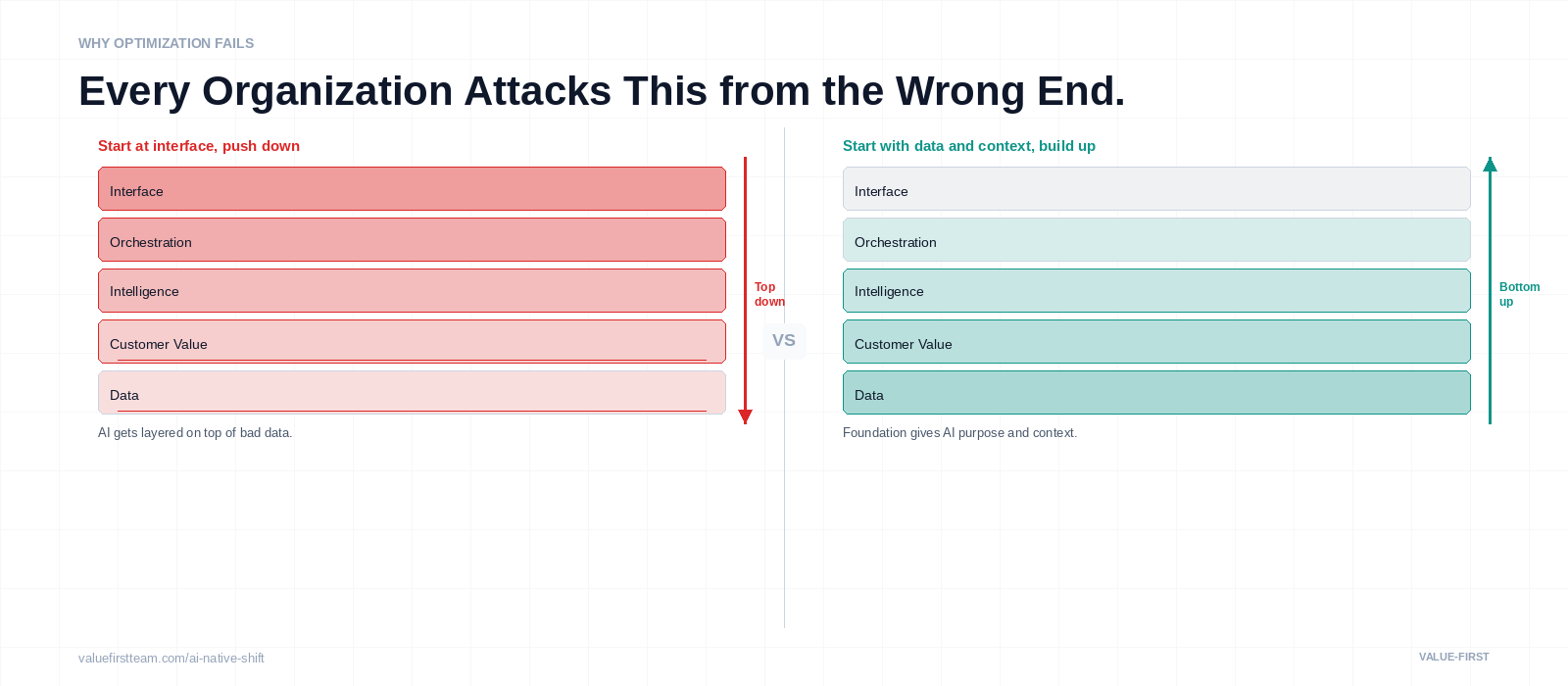
  • The five layers, stacked from Data at the bottom to Interface at the top, each with a one-line description. A red marker beside the top layer says most organizations attack here; a green marker beside the bottom layer says start here.
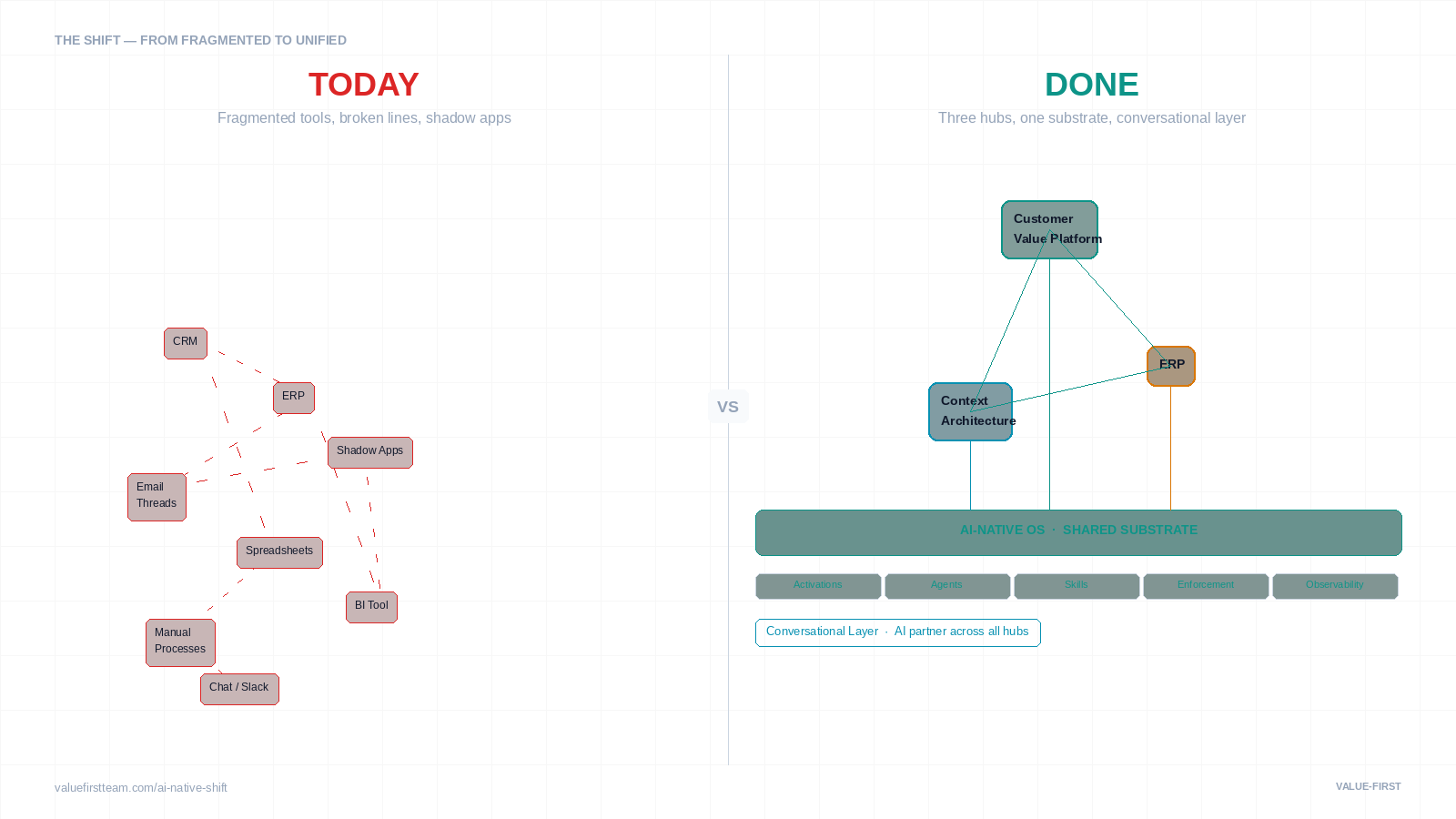
  • Two pictures side by side. On the left, "Today": scattered boxes — CRM, ERP, spreadsheets, email threads, chat, shadow apps — joined by broken dashed lines. On the right, "Done": the same systems joined to one shared substrate, with a conversational layer running across all of them.
  • The same five layers drawn twice. On the left, a red arrow points down from Interface — the usual order, where AI gets layered on top of bad data. On the right, a green arrow points up from Data — the order where the foundation gives AI purpose and context.
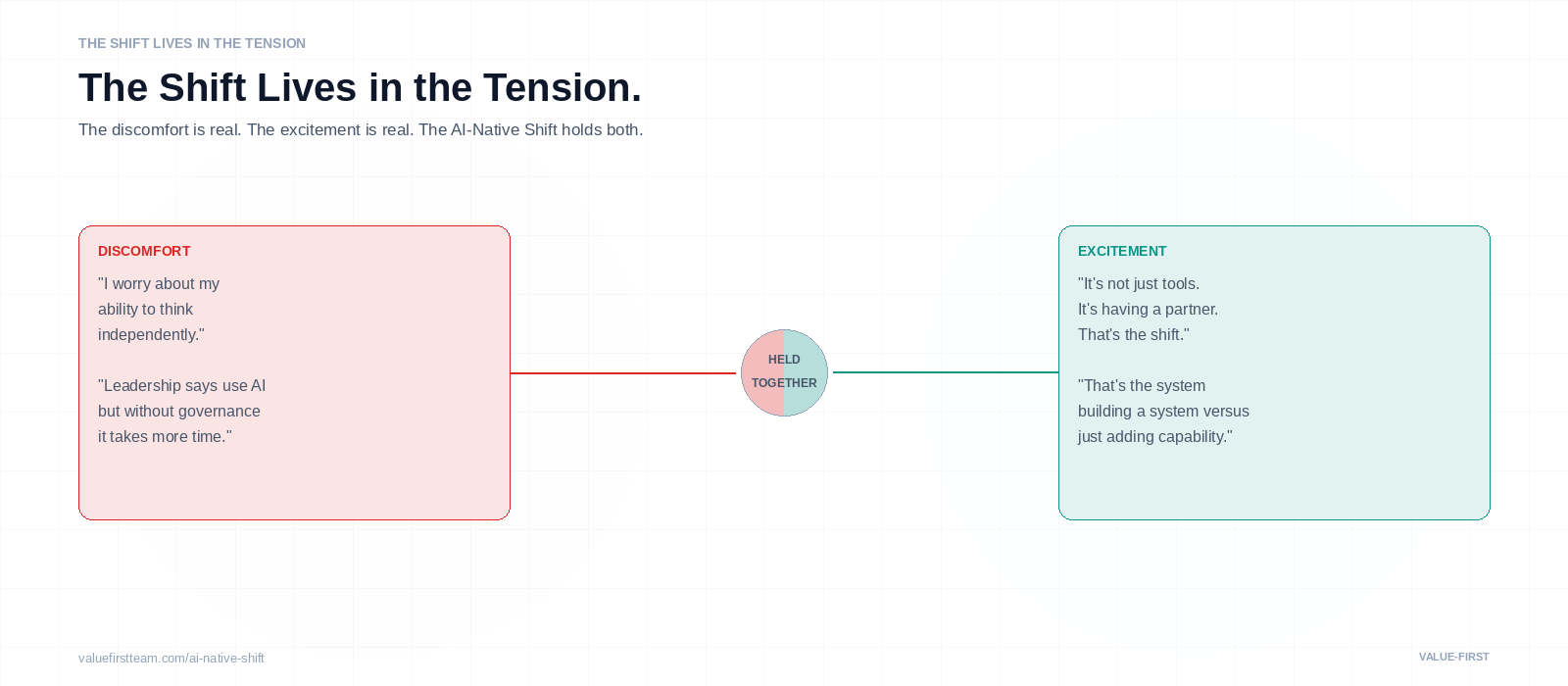
  • Two quoted panels facing each other — what people find uncomfortable on one side, what excites them on the other — joined by a line running through a small circle in the middle that reads "held together."